
Saline County Projected Release Dates
A projected date is a calculation, not a completed custody event. For most modern determinate Illinois prison sentences, IDOC uses Projected Parole Date for the expected move from prison into mandatory supervised release. Mandatory supervised release, often called MSR, is a period of community supervision required after prison. The separate Projected Discharge Date forecasts when the whole IDOC sentence and supervision period should end.
An actual Parole Date paired with Offender Status: PAROLE is much stronger evidence that the prison-to-supervision transition occurred. Final discharge comes later. A sentence line marked SENTENCE DISCHARGED?: YES applies to that one sentence line and does not prove that no other sentence remains active.
Which Saline Release System Applies
The correct source follows the custodian. A pretrial detainee at Saline County Jail may wait for a release or detention ruling, case disposition, or another court order. There is no sentence-based date to calculate before trial. Illinois now uses pretrial release and pretrial detention terms for current cases. Older docket entries can still include bond history, but that language should not be imposed on a new case.
| Custody situation | Best release-date source | What to verify |
|---|---|---|
| Saline County pretrial detention | Court docket and Sheriff's Office | Legal order plus actual jail exit time |
| Saline County jail sentence | Sentencing order and jail record | Sentence, jail credit, completion, and disposition |
| IDOC prison sentence | IDOC Individual in Custody Search | Projected Parole Date, status, actual Parole Date, and projected discharge |
| Federal prison sentence | BOP Inmate Locator | Projected or past federal release date and current BOP status |
A county jail transfer to IDOC is not community release. The sheriff's record can show that Saline County custody ended, while the mittimus, which is the court's commitment order, and IDOC admission show that state custody continued.
Find Saline County Release Dates
For a state commitment, begin with the IDOC Individual in Custody Search. The underlying search accepts last name, IDOC number, or birth date. An exact IDOC number is the strongest key. Name searches should account for suffixes, maiden names, hyphens, and switched first or middle names.
- Confirm whether the person is in Saline County Jail, IDOC, federal custody, or another agency's custody.
- For IDOC, search by IDOC number when known. Otherwise compare the name and birth information carefully.
- Open the full profile. Read Offender Status, Projected Parole Date, Projected Discharge Date, sentencing county, and mittimus number together.
- For county custody, obtain the court order and ask the Sheriff's Office for the existing booking and release record.
- Return after the expected date and look for an actual status or source release entry.
The Saline County released inmate lookup provides the broader path when the custodian is uncertain. Never treat roster absence as proof. A person can be missing because of transfer, spelling, delay, restriction, or final discharge from an index.
Read Saline IDOC Date Fields
An official IDOC in-custody profile example displays the future date labels used in the state system.
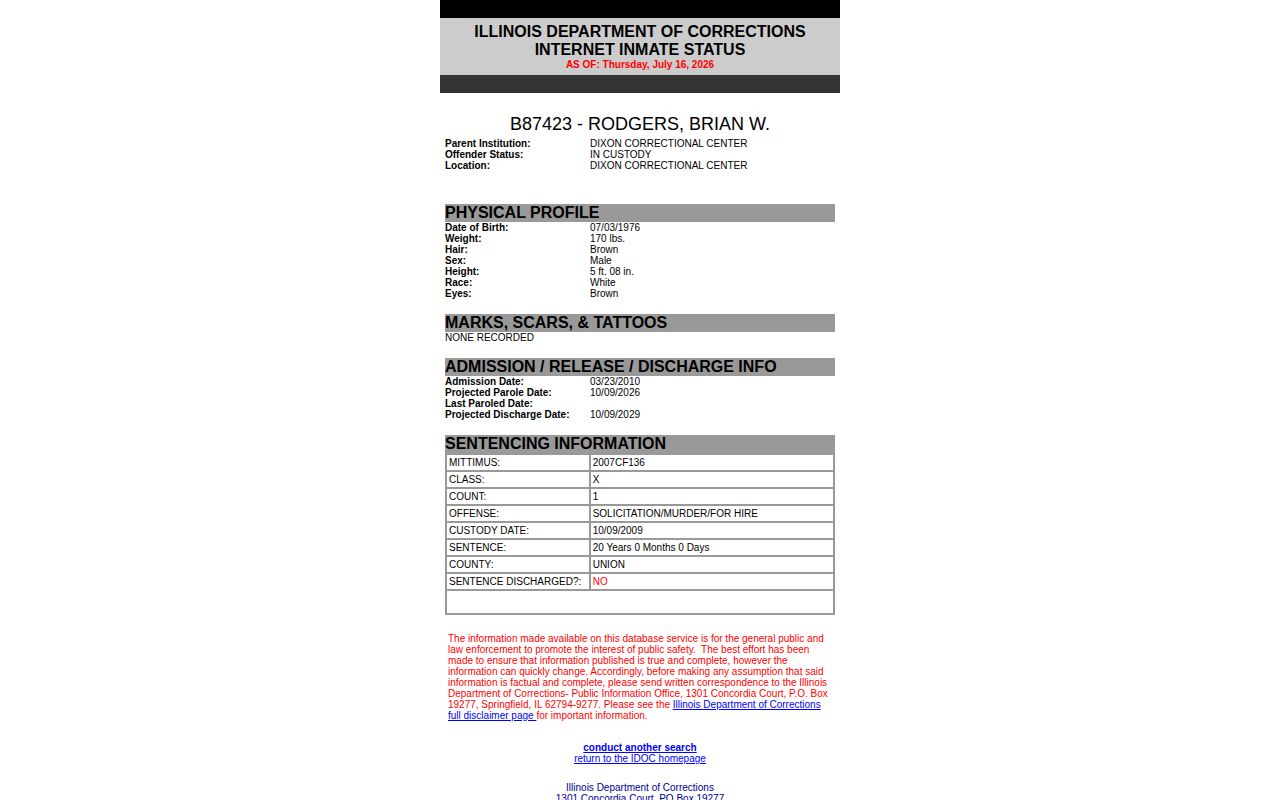
The example shows why the full record matters. Projected parole and projected discharge describe different points, and neither is an actual release entry while the profile still says in custody.
Illinois Credit Shapes Release Dates
The Illinois sentence-credit law, 730 ILCS 5/3-6-3, does not support one percentage for every prisoner. Depending on the offense, offense date, sentence law, and exclusions, the statutory framework can result in effective service commonly described as 50, 75, 85, or 100 percent. Eligible day-for-day credit is often described as 50 percent. Specified truth-in-sentencing offenses cap credit at 4.5 days per month, commonly described as about 85 percent. Other listed crimes use a 7.5-day monthly cap linked with 75 percent, while some require the full term.
Earned Sentence Credit is additional and discretionary. Possible eligibility is not an award. Program participation, conduct, exclusions, and IDOC findings can affect it. Natural-life sentences do not receive ordinary sentence credit. The law also places floors on reductions for some truth-in-sentencing terms.
IDOC's Records Office calculates the state date from the sentence, commitment, jail credit, whether terms run at the same time or back to back, and the credit law that applies. The Illinois Prisoner Review Board does not choose the release date for most determinate sentences. It sets MSR conditions and handles defined hearings and violations.
Note: A simple sentence-length calculator cannot reproduce an official IDOC date safely because the controlling inputs differ by case.
Why Saline Release Dates Change
A displayed date can move before the event. The most useful response is to preserve the old result and check the source again, rather than predicting how one change will affect the total term. IDOC says an eligible Earned Sentence Credit adjustment is communicated to the person and reflected in the public profile.
| Factor | Possible effect | Where to confirm |
|---|---|---|
| Credit award | May move a projected date earlier when law and IDOC action allow it | Updated IDOC profile or IDOC record |
| Credit loss or restoration | Can change the calculation after discipline or review | IDOC record |
| Corrected jail credit | May alter time credited before state admission | Court order and IDOC calculation |
| Concurrent or consecutive terms | Changes whether sentences overlap or run one after another | Commitment and IDOC record |
| New sentence or recommitment | Can extend or replace a prior forecast | Court, IDOC, and PRB records |
| Warrant or detainer | May cause transfer to another custodian instead of community release | Holding agency and court record |
A detainer or warrant can change the destination without changing the fact that one facility released the person to another authority. Record the receiving agency. “Released from IDOC” and “free from all custody” are not always the same statement.
Two Saline Projected Dates
The two public IDOC labels have special importance when a Saline County mittimus sends someone to state prison. Projected Parole Date forecasts the end of the prison portion and start of supervision. Projected Discharge Date forecasts the end of the full state sentence and its supervision. The dates can be far apart because release from prison does not end IDOC authority.
- Projected Parole Date
- The calculated future prison-to-supervision milestone for the profile.
- Parole Date
- The actual recorded date of release from prison to supervision when supported by parole status.
- Projected Discharge Date
- The expected end of the complete IDOC sentence and supervision.
- Final discharge
- The later event that ends IDOC jurisdiction.
The public often calls modern supervision parole. IDOC uses parole labels in profiles, while PRB describes the modern term as mandatory supervised release. A Projected Parole Date in a determinate case should not be described as a promised discretionary grant vote.
Saline Jail Release Calculations
Saline County has not published an online county-jail good-time policy or sentence calculator in the material reviewed. Do not apply IDOC percentages to a local jail stay. The sentencing order, recorded jail credit, and Sheriff's release record control the local inquiry. No Saline-specific weekend-release rule was found either.
The Saline County Circuit Clerk's docket can identify a sentence, time-served disposition, probation order, or mittimus. Yet the court order and jail record answer different questions. The order supplies legal authority. The Sheriff's Office supplies the actual date and time the person left, plus the release or transfer disposition that it recorded.
If a future county date matters, ask for the existing record rather than asking staff to create a calculation. Illinois FOIA provides access to records; it does not require an agency to answer a questionnaire or generate a new report. A focused request can seek the booking time, release time, disposition, authorizing order, and receiving agency if maintained.
Older Saline IDOC Release Records
IDOC's live search shows people who are incarcerated or on parole. Once the whole sentence is complete, the profile ceases to display. Therefore, a blank search does not prove that a person never entered IDOC or that release occurred on a particular date.
For an older record, use IDOC Contact Us and choose Record Search. Provide the full name, birth date, approximate year received, likely facility, conviction county, and useful dates. Public archived material may include the IDOC number, parent institution, status, admission and release dates, and sentencing information. Some information remains confidential.
Compare the archive response with the Saline County commitment. One discharged sentence line may coexist with another active sentence. Match the IDOC number, mittimus number, offense, and sentencing county rather than relying on the name alone.
Confirm Saline County Actual Release
After the projected day passes, look for an affirmative event. In IDOC, that can be an actual Parole Date paired with parole status. For Saline County Jail, request the discharge or transfer timestamp and disposition. VINE can provide a pending event alert, but its feed does not replace either source record. Registration steps and event limits are detailed on the Saline County VINE Inmate Check.
When sources conflict, record their timestamps. A court order may authorize release before the jail finishes holds, identity checks, property return, and administration. A VINE update can follow the jail. Contact the current custodian and avoid calling the delay an error until the source agency clarifies it. If the exit was a transfer, record the receiving agency and continue with that custodian rather than treating the projected day as community release.
Match at least two strong identifiers: full name and date of birth, IDOC or booking number, case number, admission date, or sentencing county. Preserve exact labels such as IN CUSTODY, PAROLE, Projected Parole Date, Projected Discharge Date, and transfer. Those words carry the difference between a plan and a completed event.
Official agency records control the final finding.